Evolution: What Can Steller's Jays Tell Us About the Species Concept?
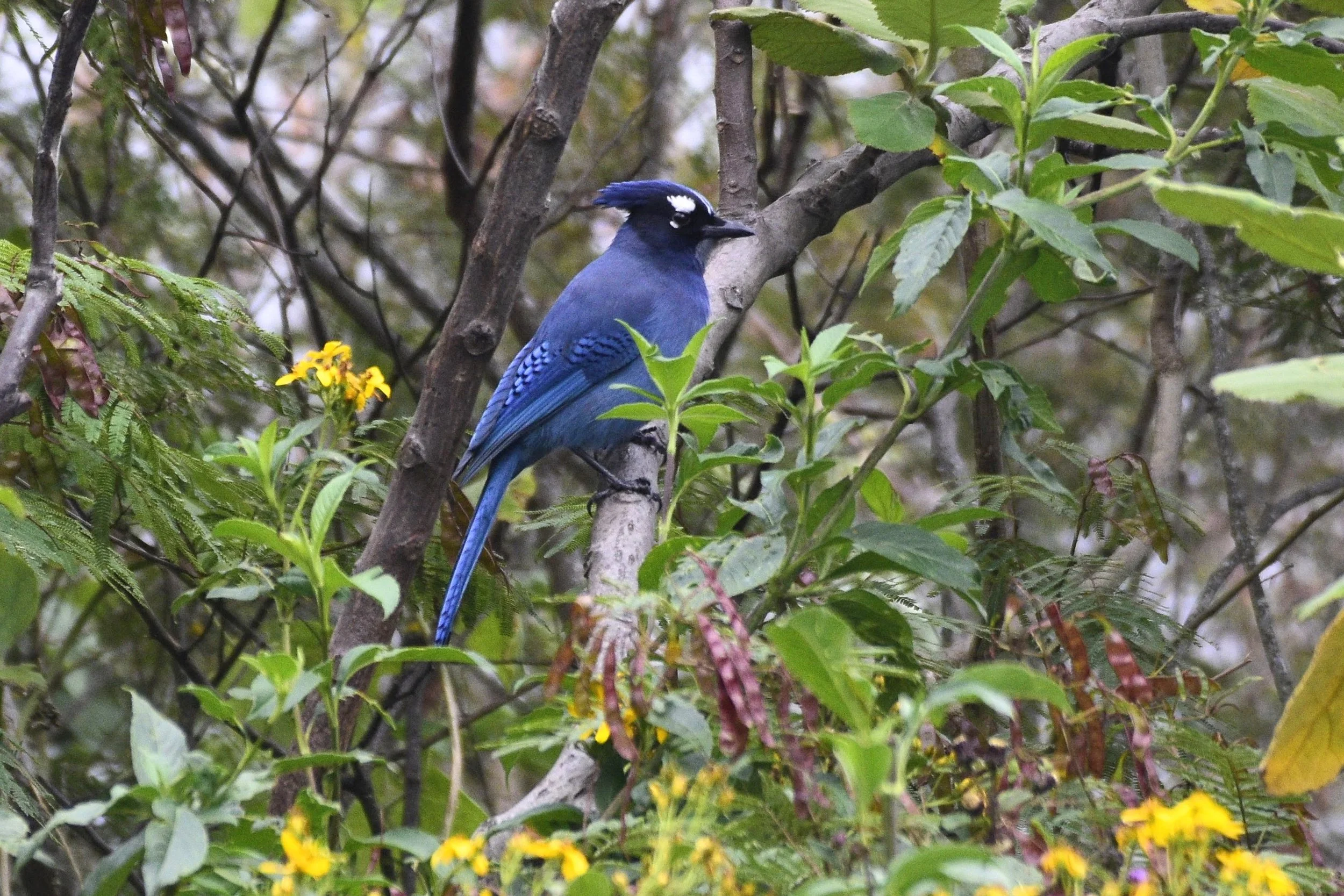
Steller’s Jay photographed in southern Oaxaca, Mexico on November 27, 2022. Credits @David Tonnessen.
The recent paper on the Steller’s Jay Cyanocitta stelleri complex, which can be found in the Wiley Library here, has got me thinking back on the topic of species. Naturally I spend a lot of time pondering this concept, but this time a new conundrum presents itself to join the range of issues associated with defining populations of organisms as “species".
So, let me break down this Steller’s Jay paper. Basically, the authors conducted a phylogenetic and morphological study of Steller’s Jay, a species that ranges in dense montane conifer forest across the western half of North American from Alaska all the way down to northern Nicaragua.
What the authors find is that Steller’s Jays forms along the US and Canada pacific coast through western Wyoming and southeastern Idaho have relatively widespread gene flow and hence, relatively consistent morphological features throughout, with the biggest morphological gradients happening from the coast inland to individuals in Montana, Idaho and Wyoming. But if you head south from this point, there is a steep gradient of features that change all at once over a small geographic area, to be reflected throughout the central and southern Rockies of the four corner states (Utah, Colorado, Arizona and New Mexico). Because this is a narrow zone with a steep gradient, this fits the “narrow hybrid zone” qualification for considering two populations of closely related organisms as different species, as has been defined in modern ornithology. This separation also aligns with the geographic limitations of other close sister species and subspecies in the US; namely Cassin’s and Plumbeous Vireos and the ever messier Pacific-slope Flycatcher and Cordilleran Flycatcher gradient.
So, the complex gets split at least in half. But what about Steller’s Jays as you go further south, to Mexico and then Central America? Well, the authors didn’t assess any populations south of the US-Mexico border.
Steller’s Jays in southern Mexico and Central America are arguably the most divergent from the rest of the clade, by morphology. That’s why I did a quick and dirty search of Steller’s Jay images to assess morphological differentiation along many different latitudes in Mexico and into Central America, to identify any significant and sudden leaps in morphological difference which could translate to a botch in gene flow. To do this, I assessed five of the best rated Steller’s Jay photos from each of the following regions; state of Sonora, Mexico, state of Durango, Mexico, state of Mexico, Mexico, state of Oaxaca, Mexico, state of Chiapas, Mexico, Guatemala, and Honduras. What I found is that morphological differences changed gradually across latitudes in Mexico, with northern Mexico birds looking very much like birds in the US Rockies, with blackish heads, thin white eyebrows and white frontal streaks, while birds in Oaxaca show a much bluer head, very bushy white eyebrows, and light blue frontal streaks fading into a darker blue crest. Birds in between these locations including in the state Mexico and in Veracruz showed features intermediate to these extremes. Then, birds in Chiapas, Guatemala and Honduras all sport a similar morphology to each other and Oaxaca but with two key differences from birds in Oaxaca. In Chiapas, Guatemala and Honduras, Steller’s Jays sport two key morphological differences; an even bluer head, and a floppy crest that is usually flat against the head as if to suggest no crest at all, and
This more sudden change is due to a break in the species’ distribution at the Isthmus of Tehuantepec, which is the narrowest part of Mexico and a valley which separates the highland coniferous forests. This is the only known break in its distribution and therefore its gene flow, in its Mexico range. The Isthmus is no stranger to species and subspecies delimitations, as it acts as a geographic barrier to many other highland species as well, including the closely related Bumblebee and Wine-throated Hummingbird, two subspecies of Brown Creeper, multiple closely related jay species of the genus Cyanolyca, among others.
Links to examples of Interior Steller’s Jays, ordered north to south:
Colorado: https://macaulaylibrary.org/asset/267972091
Durango: https://macaulaylibrary.org/asset/124983321
Puebla: https://macaulaylibrary.org/asset/353119191
Veracruz: https://macaulaylibrary.org/asset/499838911
Oaxaca: https://macaulaylibrary.org/asset/455359021
Honduras: https://macaulaylibrary.org/asset/291000741
What this morphological analysis could suggest is that Steller’s Jay morphology changes very gradually from north to south in Mexico because of connected populations and gene exchange, but suddenly across the Isthmus morphology takes a small “leap” because of botched gene flow. An in-depth genetic study would be useful to back this up and gain a more complete picture of gene-flow, however.
But if this is indeed an accurate picture of what’s going on, using our current model for species recognition in birds (see my post on taxonomy and the species concept), Steller’s Jay would be split into three species; a US-Canada pacific form, a US-Mexico interior form, and a Mexico-Central America form east of the Isthmus. The conundrum here lies with the fact that Steller’s Jays just across the isthmus from this last form, in Oaxaca, are morphologically and genetically closer to Steller’s Jays just east of the Isthmus than to Steller’s Jays in say, the state of Colorado, yet would be considered the same species as those in Colorado but not in Chiapas, because of connected gene flow.
I think my point here is that we need a more fluid way of acknowledging variation in organisms, and become comfortable with the fact that we can’t just neatly box populations off into categories. We need a system that recognizes organisms as multi-dimensional gradients. For example, when we read literature that states there are "thirteen recognized subspecies” of Brown Creeper, this incorrectly implies that there are thirteen different boxes that any individual Brown Creeper can be assigned to. In most cases, these subspecies are really continuums.
References:
https://academic.oup.com/jhered/article/105/S1/741/852836
https://ebird.org/home
https://onlinelibrary.wiley.com/doi/epdf/10.1002/ece3.9517?fbclid=IwAR2Nx30XsRIacmy4YlMLF7HHAOcQPGkyLr8aIcVeOQEvkiJs0waIcAKUe_U